Hi! I'm Colin Anderson. I've been working in tech for 25 years, including a decade of managing technical teams and, most recently, a decade of running all aspects of L&D for a hosting/managed services company. No matter my position, I excel at creatively solving business problems quickly and cost-effectively. I enjoy writing and have three (so far!) published short stories. As a game dev hobbyist, I am creating a computer game which I plan on releasing in 2026.
I am looking for a Learning and Development role as I really do like helping people unlock new skills and grow professionally. Finding creative ways to keep training engaging and beneficial outside of simply creating training modules to put in an LMS (although this is important too) is what keeps me engaged in the process. I am comfortable working with most eLearning authoring tools and learning management systems, but I have created an entire training catalog on an LMS using completely free software.
I can handle any or all of the various L&D responsibilities from collaboration with leaders and SMEs, designing, creating, deploying, and delivering training modules. I can build, configure, and administer servers as well as the LMS software running on them. I can build proprietary certification courses to ensure learners' understanding of important concepts and proof they can act on that knowledge. If the job requires it, I can manage and lead staff.
Click to message me on LinkedIn so we can chat!
Customers of my former employer (the company) have servers hosted with the company and/or public cloud environments and have full root/admin access to their servers and could install whatever they want and use the servers for any purpose. With some exceptions, support’s job was to assist with any problems, questions, or requests customers may have. Customers were expressing dissatisfaction with support via NPS surveys and conversations with management, commonly citing “knowledge” as an issue with how their support requests were handled. I was tasked with improving the support skills of new-hire and first level support representatives who work with these customers. I will provide my solution in the context of high-level ADDIE steps which will provide insight into the decisions I made:
Analysis:
“Improving support” with a focus on “knowledge” is a pretty vague and potentially wide-ranging goal, however that’s often how requests initially come into L&D! Given the environments support reps were tasked to assist with (servers that may have anything installed or serving any purpose), a set of specific technology or specific software focused courses were unreasonable, and in reality, redundant given online resources, vendor documentation, etc. Through working with management and some support reps directly, we determined that not knowing the specifics of a technology/software wasn’t always the problem. Confidence, knowing which steps were/weren’t appropriate to take, and understanding of which internal resources were available and when to use them were stumbling blocks. We (managers, support reps, and I) decided to focus on support reps’ confidence as a creative goal that training could certainly assist with. I suggested a hands-on, real-world sandbox system in which we can provide support reps with common customer requests and the servers the reps can log into and address those requests.
Design:
I didn’t run an action mapping exercise initially for this project (although it would create the need for different action maps once it was complete), because what I was really envisioning was creating a framework in which training modules would be deployed. I began the design process from the end user’s perspective. “I go to a website, select an exercise, read the ‘customer request’, I log into the server to fix the issue/handle the request, I click ‘done’ on the website, I see my pass/fail assessment.” I wanted to give support reps a place to try to do “real” work without pressure or consequences if mistakes are made. Additionally, as the only employee in the training department, I wanted to automate as much of this as possible!
Development:
I secured two older rackmount servers and configured an ESX cluster with them. As potentially the biggest cost, I was able to just use hardware that wasn’t needed anymore (a cluster isn’t necessarily even needed, just nice to have). In the cluster, I deployed a windows server to handle AD exercises as well as to serve as a DHCP server for the environment (the idea is to allow any number of participants to run exercises at the same time). I also deployed some Windows and Linux VMs and installed various software on them which would simulate customer environments with purposely “broken” configurations. I templated these VMs to await on-demand deployment when users wanted to run exercises. I then deployed a CentOS VM to serve as the front-end to the system. On this VM, I configured a LAMP stack to provide the website participants would access, the bash and powerCLI scripts to deploy and communicate with VMs for the exercises, and a SimpleSAMLphp setup to have participants authenticate with the company’s AD for tracking. The exercises’ parameters (VM templates needed, simulated customer request, pass/fail criteria) were all stored in MySQL. The overview of tech used:
- ESXi nodes on Dell rackmount servers (I have successfully tested on AWS, Azure, and Proxmox)
- Bash scripting, PowerCLI, and Powershell
- Apache
- PHP
- MySQL
- Cron jobs
Implementation:
I handed the URL to the finished system to support managers so they could assign support reps as they felt necessary. New hires were automatically assigned to run through the available exercises. Without limitation, any support reps (or anyone in the company if interested) could access the website, select exercises (examples- “broken wordpress”, “mysql down”, “join DC to AD”) to attempt and receive pass/fail assessments. Anyone accessing the system would log in with their AD credentials so their assessments would be accurately tracked to them. When users were finished, the resources deployed for their exercise were destroyed. Cron jobs ran overnight to clean up any lingering resources (if someone abandoned an exercise instead of finishing it).
Evaluation:
Immediate feedback from managers and support reps was completely positive. The initial exercises not only helped build confidence in addressing technical issues, it reinforced steps taken in the company’s internal systems to find resources, credentials, and information needed to address customer requests. NPS did tick upward in the following months, and suggestions from users prompted subsequent additions to the system including numerous different specific exercises, the ability for managers (or anyone) to generate their own exercises and deploy them within the system, usage of the system as screening for interviews, and a gamification leaderboard (exercises are timed, so the quickest completions could be listed).
Below is a quick, general walkthrough of the user's experience with screenshots:
User selects an exercise
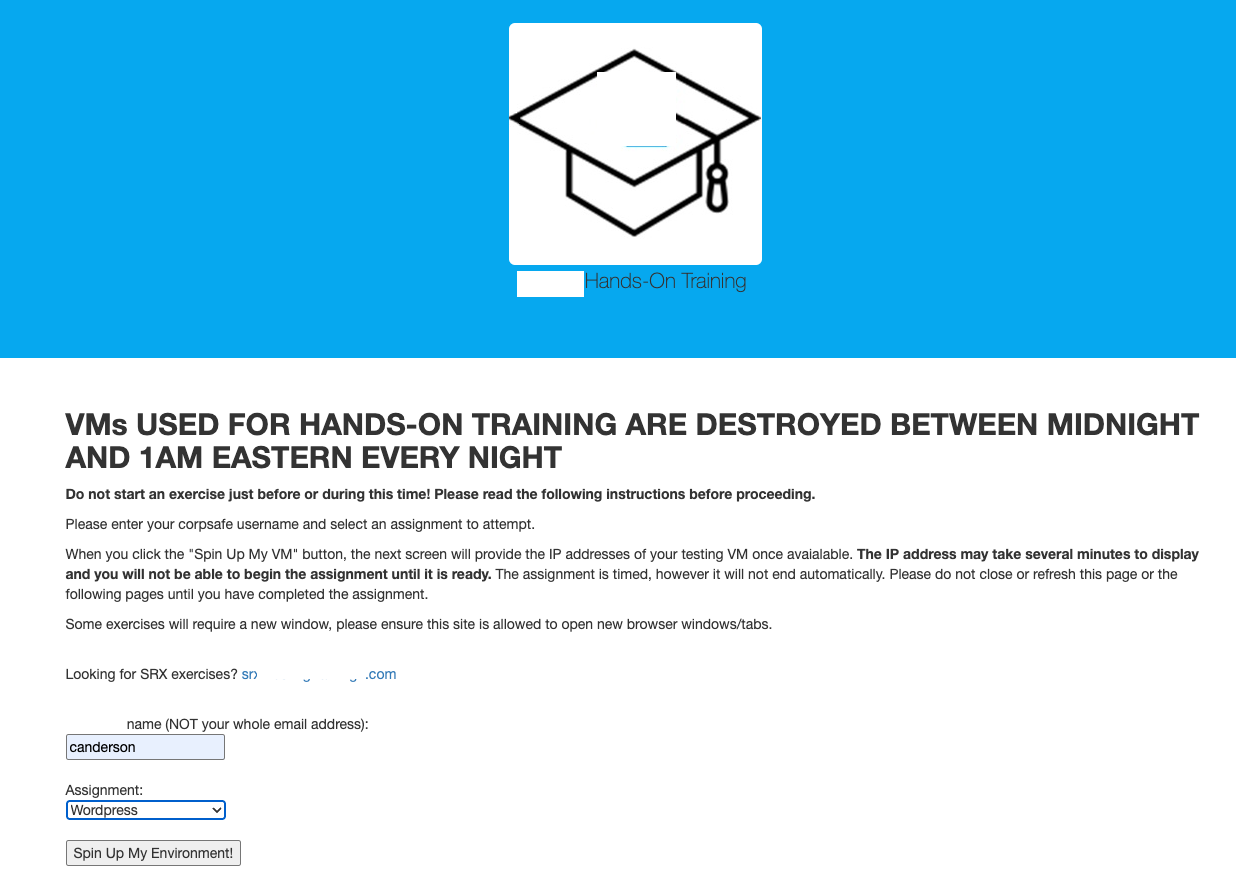 User clicks "Begin Exercise" after waiting for VM to spin up and get IP
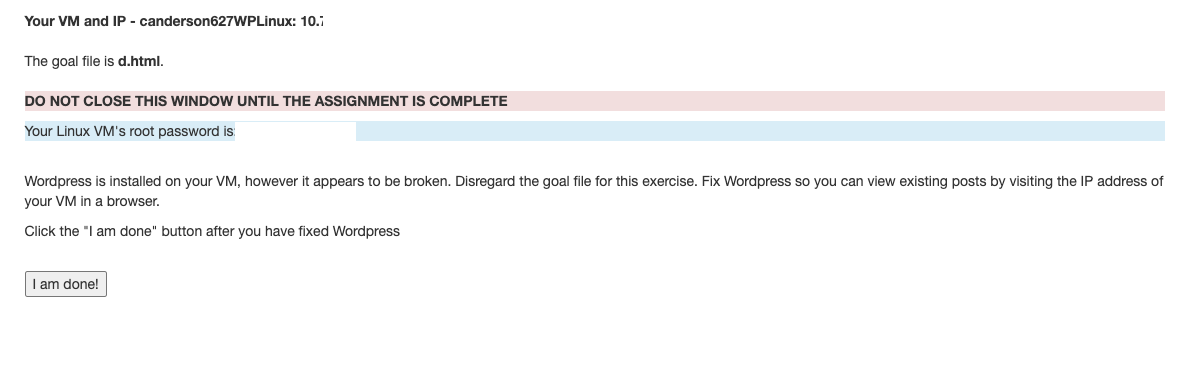
 User reads the request, attempts to fix via SSH to the server described, and clicks "I am done"
 User sees the results

Every exercise provides a newly deployed virtual machine with a randomized problem or simulated customer request (based on the type of exercise- Apache, IIS, Wordpress, MySQL, etc). The VM has its own IP address from a DHCP pool and can be accessed via SSH or RDP for investigation and attempts to "fix". When the user clicks "done", the amount of time taken (starting when they start the exercise, not including time to spin up the VM) to complete the exercise as well as pass/fail status is recorded. The VM is then destroyed (there is also an automated job to destroy any lingering VMs every night if the user never clicked "done").
One important, foundational aspect of L&D is understanding business or employee needs so a solution can be developed and delivered. Spend enough time gathering these needs, and you’ll probably start identifying needs that require solutions that fall outside of traditional L&D responsibilities. However, when I see a need that I know I can help with, I’ll go ahead and provide a quick solution.
These are website-based apps I developed myself to address the problems outlined. There are certainly 3rd party or enterprise software solutions which would solve most of the problems. However, as the company had no solutions at the time, I provided very specific solutions which didn’t require investment, installation/configuration time, or any significant learning curve for the users. These are all created with PHP/MySQL on an Ubuntu server unless otherwise specified.
Feel free to click on any of the apps to get an idea of how they work. They are database driven, however, the databases are read-only for security purposes in these examples so entering data in any forms WILL produce an error in these app examples. Additionally, these apps use SimpleSAMLphp for authentication in the corporate environment, but require no authentication for viewing here:
| Problem | App Solution |
| We need to know which employees hold which professional certifications, when the certifications expire, reminders sent to those with expiring certifications, which certifications are needed to meet partner status levels, etc. |
Certificationarium provides every employee the opportunity to self-report certs they have achieved. Managers can run reports for their teams or individual employees. Partner managers can assess where the company meets partnership cert requirements and where they need to focus on achieving more certs. |
| Leadership needs to know which contractors are working on which projects. Managers need to easily assign projects to contractors and be notified of project updates. Automated reports are sent to anyone who needs one. |
Projector |
| Compliance Department needs to ensure certain employees are reading and acknowledging policies. Reports need to be generated for auditors. |
Poliseer lets compliance management link and assign policies to single employees or groups of employees. Every employee logs into Poliseer to read and acknowledge policies. Reports can be provided to auditors to show compliance. |
I like creating useful sites, but making sites that are just for fun can be great learning experiences too. For example, I'm working on a not-real-money fake sports betting site (users can just pick games with betting lines, there's no wager amounts).
ESPN has some public facing APIs that provide JSON data that includes upcoming games and betting lines.
I don't know if there's any limitation on accessing these APIs (most places that offer data like this have some sort of free trial before charging subscription fees), so I have a cron job to access the data once an hour which is then stored in a database instead of hitting the API every time a visitor comes to the site.
saucyweasel.com
I also enjoy writing, and have a few short stories published (with at least one more on the way!). I have a story in each of the following books, available on Amazon, some local bookstores, or directly from Oddity Prodigy:
A Lovely Evening in Scary Stuff
A Wizard for the Tunnels in Beneath the Yellow Lights
The Ballad of Cornman in Where Legends Walk